Soccer Kicks Pro - Football
- 3.0
- Rating
- 10.00K
- Installs
- $0.99
- Price

 Analysis by App-foxy
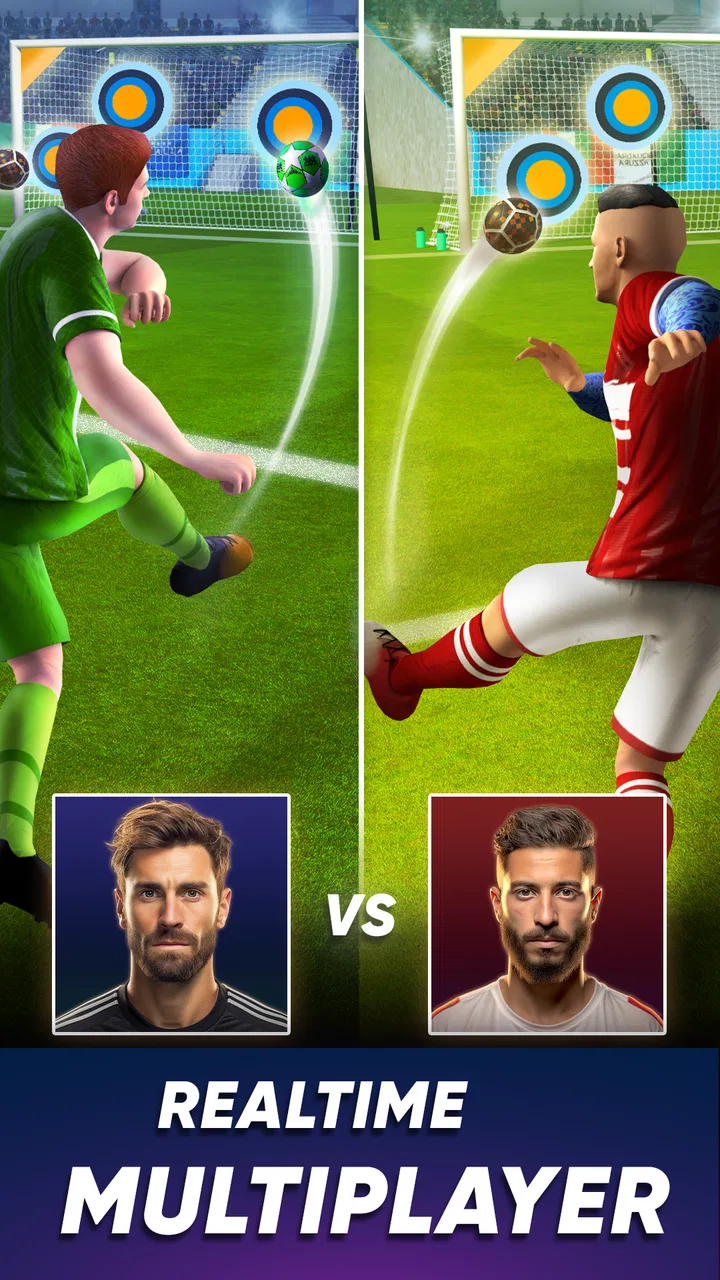
I found Soccer Kicks Pro to be a compact penalty-kick game built around one clear idea: step up, aim, and try to beat the goalkeeper. It belongs to the sports category, and its focus is much narrower than a full football simulator. That simplicity is the main reason I can imagine opening it during a short break, although it also explains why players looking for complete matches, team management, or a deep career mode may quickly want something else.
The game is developed by INLOGIC PREMIUM - football soccer tennis sport and is available for $0.99. It is rated for Everyone, so its basic football theme is suitable for a broad audience. The app was released on October 21, 2022, and the current version is 2.2.11, with support beginning at Android 7.0. Those details make it a relatively accessible option for people using an older Android phone, provided the device runs that system version.
What I like immediately is that the central activity is easy to understand without a long explanation. You are not asked to learn a complicated control scheme before taking a shot. The appeal is closer to a quick arcade challenge than to a serious football match. The average rating sits at 3.0 from around 478 ratings, with about 48 written reviews, while the game has passed 10K+ installs. That reception suggests a mixed experience, and after spending time with it, I understand why: the basic idea is approachable, but its limited scope will matter a lot depending on what you expect from a football game.
You May Also Like

 Blood Strike: 2.5 Anniversary
Blood Strike’s Loadouts Turn Every Drop Into a Tactical Gamble
A close look at Blood Strike’s custom loadouts: how fast access to signature weapons reshapes its battle royale rhythm, rewards preparation, and narrows the gap between fights.

 Pandora - Music & Podcasts
Pandora’s Music Is Easy to Start, but Harder to Recover
Pandora’s strength is its low-effort path from a seed to a station. Its weak spot is how much confidence it asks you to place in connection, setup, and quiet recovery.

 8 Ball Pool
 Is Built on Rivalries, Rematches, and Routine
A close look at the rivalries, rematches, shared routines, and unanswered safety questions that turn a quick pool match into a persistent mobile community.

 Samsung Music
’s Quiet Strength Is Playing What You Already Own
Its reach comes less from spectacle than from dependable access to a personal library. That simplicity is both the app’s strongest retention engine and its ceiling.

 AccuWeather: Weather Radar
AccuWeather Review: A Quick, Clear Forecast for Everyday Decisions
For everyday plans, the best forecast is the one you can understand quickly. AccuWeather makes rain timing, radar, and local conditions easy to act on, with a few trade-offs.

 Hill Climb Racing
Why Hill Climb Racing Still Turns Crashes Into One More Run
A tiny car, a bumpy hill and one more upgrade: Hill Climb Racing keeps resurfacing because its simple chaos makes every near-miss feel personal.
More From Our News Desk



How clearly the game communicates what to do
I focus on how plainly the game explains its central task, because a penalty challenge works best when players can spend their attention on the shot rather than decoding the interface. I also consider the difference between recognizing the goal and understanding why an attempt succeeds or misses. That distinction matters especially when someone is picking up the game for a brief, casual session.
Readability and navigation during a quick session
The strongest usability quality is the directness of the concept. A player who understands a penalty kick can usually grasp the purpose of the game quickly. There is no need to manage a squad, remember a large set of buttons, or study tactical menus before enjoying the first attempt. That makes it a reasonable choice for a child, a casual player, or someone who wants a football-themed distraction rather than a long gaming session.
I also think the focused format helps when attention is limited. If I only have a few minutes, a penalty challenge is easier to approach than a full match that expects me to commit time to several phases of play. The game’s identity is clear: it is about finishing chances from the spot, not recreating every part of football. That clarity reduces the mental load for new players.
There is an important trade-off here. A simple game can be welcoming, but it can also leave less room for recovery when something is unclear. In a larger football title, another mode or menu may offer a different way to understand the controls. In this kind of focused experience, the quality of the aiming interaction matters much more because nearly everything depends on it. If the visual guidance or timing feels unclear on a particular phone, there is not a separate football activity to soften that frustration.
For a younger player, I would recommend staying nearby for the first few attempts. The Everyone age rating makes the content broadly appropriate, but age suitability and ease of use are not exactly the same thing. A child may understand the goal immediately and still need help interpreting where to aim or why a shot did not behave as expected. Once the basic rhythm makes sense, the game is much easier to approach independently.
Why the narrow format can be useful
The penalty-kick structure works well in situations where a full sports game would be excessive. I can see it fitting into a short commute, a waiting room, or a brief break between tasks. It does not ask me to build a team or follow a season before I can do something recognizably football-related. That is a practical strength, especially for people who enjoy the feeling of taking a decisive shot but do not want the responsibilities of a full simulation.
It may also suit players who prefer one repeatable action that they can gradually refine. Instead of dividing attention among passing, defending, running, and formations, I can focus on the relationship between direction, timing, and the goalkeeper. This concentrated loop makes the game easier to pick up after a gap of several days because I do not have to remember a complicated control layout.
My advice is to treat it as a small arcade game, not as a replacement for a complete football title. That expectation makes the experience more satisfying. If I download it hoping for a full match with realistic team control, the limited format will feel disappointing. If I want a quick test of my finishing instincts, the design makes more sense.
Motor and sensory considerations
The main physical demand is precision. Penalty games often look simple because they use fewer controls, but a small number of controls does not automatically mean low effort. The player still needs to make a controlled gesture or tap at the right moment, and the result can depend on how accurately that action is performed. Someone with reduced fine-motor control may find the central challenge more demanding than a menu-based sports game.
That does not make the game unsuitable for every player with motor limitations. The focused control scheme may be easier than a football simulator with several virtual buttons active at once. A person who can make short, deliberate touches may prefer this over a game requiring continuous movement and rapid switching between actions. The useful question is not whether the game is universally easy, but whether its single main interaction matches the player’s own control comfort.
Screen size can change that experience. On a smaller phone, aiming areas and visual targets may feel crowded, while a larger display can make the same action easier to inspect. I would test the game in both portrait and landscape holding positions if the device allows comfortable rotation, because the way the phone is held can affect steadiness and thumb reach. I would also avoid playing one-handed if that makes the aiming motion less controlled.
Visual attention matters as well. The player needs to distinguish the goal, the goalkeeper, and the direction of the intended shot. Anyone who has difficulty with small moving objects, contrast, or fast visual changes may need more time to understand the action. I did not treat the game as having specialized accessibility support, so I would not recommend assuming that it includes custom text scaling, alternative color schemes, spoken guidance, or switch controls. Those are important considerations for players who depend on them.
Sound is less central to the basic decision-making than the visual action, which can be helpful for someone playing quietly or in a noisy place. At the same time, players who rely on audio cues should not assume that every useful event is communicated clearly through sound. For a more inclusive session, I would first play a few rounds with the device volume low and check whether the visual information is enough. If it is not, the game may be a poor fit for someone who cannot comfortably depend on the screen.
Situational access in everyday use
One realistic use case is a short pause during a work or study day. I can open the game, take several shots, and stop without feeling that I have abandoned a long match. That makes it more flexible than many sports games, especially when I am using a phone in a place where I cannot give constant attention for twenty or thirty minutes.
It can also work for casual sharing between family members. Because the idea is immediately recognizable, one person can hand the phone to another without explaining a full set of football rules. A parent and child could take turns attempting shots, although the experience is still best understood as informal pass-and-play rather than a dedicated local multiplayer product. I would not buy it specifically for group competition, but it can provide a simple challenge when people are already together.
For older devices, the minimum requirement of Android 7.0 is encouraging. It means the game is not restricted to only recent phones, which broadens its practical reach. Still, operating-system compatibility is only one part of situational access. A device with a small screen, an unresponsive touch panel, or limited battery may make a precision game frustrating even if it can install successfully.
The $0.99 price also changes the decision. It is a small purchase rather than a free download, so I would think about the game’s narrow focus before paying. Someone who wants a quick penalty challenge may consider that reasonable. Someone who usually expects a free trial before deciding may prefer to read the store information and user feedback carefully first. The low price does not remove the central question: will repeated penalty attempts be enough to hold your interest?
Where the experience still creates barriers
The biggest barrier is repetition. Since the game concentrates on penalty kicks, the same basic action remains at the center of the experience. That can be satisfying for players who enjoy practice and incremental improvement, but it may feel thin for anyone who needs variety to stay engaged. Compared with a conventional football game, there is no equivalent here to moving the ball through midfield, organizing a defense, or making tactical substitutions.
A second barrier is precision under uncertainty. When a shot misses, a player needs to understand whether the problem was aim, timing, gesture control, or the goalkeeper’s response. If the feedback does not feel sufficiently clear, the result can seem arbitrary rather than instructive. This is especially important for children and players who need strong visual confirmation. A game built around one skill should make that skill easy to interpret, otherwise practice becomes guesswork.
There is also a difference between content accessibility and control accessibility. The football theme is harmless and suitable for Everyone, but that does not guarantee that every player can comfortably perform the required motion. Someone with tremors, limited reach, or difficulty making quick gestures may find a slower strategy game more welcoming. Likewise, a player with low vision may be better served by a title with explicit display options and stronger accessibility settings.
I would skip this game if my priority were an authentic football season, licensed teams, detailed tactics, or a broad set of match situations. I would also look elsewhere if I needed confirmed support for assistive technologies or highly adjustable presentation. In those cases, a larger sports game with documented accessibility options may be a better choice, even if it takes longer to learn.
On the other hand, I would consider it a sensible pick for someone who wants a small, focused football activity and is comfortable with touch-based precision. It is particularly suitable for casual players who do not want to memorize complex controls. The game’s compact idea is not a weakness by itself; it becomes a weakness only when the player expects the breadth of a full football simulation.
How it compares with familiar football alternatives
Against full football games, this title wins on immediacy. I can get to the defining action without handling a team or learning a large interface. That makes it less intimidating and more suitable for short sessions. Full football alternatives win on variety, realism, and long-term progression, so they are the better investment for players who want to feel responsible for an entire match.
Against other small arcade sports games, the choice depends on whether penalty kicks themselves are enough. A broad arcade collection may offer more activities but require more menus and rules. This game is more focused, which can be an advantage for a player who wants one repeatable challenge. The cost of that focus is that interest may fade sooner if the player does not enjoy practicing the same type of finish.
My practical comparison is simple: choose this when you want a quick football-flavored test of accuracy, and choose a fuller alternative when you want a football world to manage. Do not judge it by the standards of a console-style simulation, but do not ignore the limits of its compact design either. The right audience is fairly specific, and being honest about that makes the purchase easier to evaluate.
Small habits that make the game easier to use
I found that taking a moment to settle the phone before shooting is more useful than rushing through repeated attempts. Resting the device against a stable surface can reduce accidental movement, particularly for players who struggle to keep a steady grip. It is a simple adjustment, but in a precision-focused game, comfort can affect performance as much as enthusiasm.
I would also play several attempts with the same hand and holding position before deciding that the controls are inconsistent. Changing grip, screen angle, and thumb position from shot to shot makes it difficult to identify what actually caused a miss. Establishing one repeatable posture turns the session into a clearer test of the game’s aiming feel.
For children or new players, I would explain the objective in one sentence and then let them experiment rather than giving a long tutorial. The game’s appeal comes from immediate action, and too much instruction can make a simple challenge feel complicated. After a few attempts, I would ask what they think changed between a successful and unsuccessful shot. That encourages observation without turning the experience into formal training.
For players sensitive to stimulation, I would begin with short sessions and a comfortable volume level. The game is easier to judge when the player is not distracted by a bright environment, glare, or unnecessary background noise. If the screen is difficult to read outdoors, moving into shade or using a larger display may help, but I would not treat those workarounds as a substitute for built-in accessibility settings.
Who should download it and who should pass
I recommend it to casual football fans who enjoy penalty shootouts, people looking for a brief sports game, and families wanting a straightforward phone activity that does not require a large ruleset. It is also worth considering for Android users on older supported devices who want a low-cost game with a clearly defined purpose.
I would be more cautious for players who need extensive customization, depend on audio or assistive input, or lose interest quickly when a game repeats one central action. The same narrow design that makes it approachable can make it unsuitable for anyone seeking variety. A player who wants a complete football experience should spend the money on a broader alternative instead.
An inclusive verdict based on real expectations
My overall view is mixed but fair. Soccer Kicks Pro is easy to understand, inexpensive, and well suited to short sessions. Its penalty-focused format lowers the learning burden compared with a full football simulator, and the Everyone rating makes its subject matter broadly approachable. The supported Android range also gives it a practical advantage for people who do not use a new phone.
However, inclusive design involves more than a simple objective and a low price. The game still depends on visual interpretation and controlled touch input, and its focused structure offers little alternative if those elements do not work well for a particular player. I would not present it as universally accessible. I would present it as a simple sports game that may be comfortable for some players precisely because it avoids complex football controls, while still leaving meaningful barriers for others.
My recommendation is to buy it only if the penalty-kick loop is exactly what you want. At $0.99, it is a modest purchase, but its value depends almost entirely on how much enjoyment you get from repeated attempts to place a shot past the goalkeeper. For quick football breaks and uncomplicated touch play, it has a clear place. For depth, broad accessibility options, or a full match experience, I would choose another game.
FAQs for Soccer Kicks Pro - Football
01What is Soccer Kicks Pro - Football?
Soccer Kicks Pro - Football is a football-themed mobile game focused on taking shots, aiming at targets, and improving your scoring accuracy. From my experience, it is designed for quick sessions rather than full eleven-a-side matches, making it suitable for casual play. The main appeal is its simple controls, fast challenges, and the satisfaction of mastering difficult shooting situations.
02How do you play Soccer Kicks Pro - Football?
The gameplay generally revolves around controlling the direction, power, and sometimes the curve of your shot. Players must pay attention to the goal, goalkeeper, defensive obstacles, and target areas before swiping or tapping to kick the ball. Early levels are easy to understand, but later challenges require better timing and more precise movements. Practice is important because small changes in aim can significantly affect the result.
03Is Soccer Kicks Pro - Football free to download and play?
Soccer Kicks Pro - Football can typically be downloaded without an initial purchase, allowing users to try the core gameplay before spending money. However, free mobile games may include advertising, optional in-app purchases, or unlockable content. Before downloading, it is worth checking the current store listing for pricing details, available purchases, and whether advertisements can be removed.
04Does Soccer Kicks Pro - Football require an internet connection?
The basic shooting challenges may be playable without a constant internet connection, which is convenient for short sessions while travelling or when mobile data is unavailable. Nevertheless, some features can depend on online access, including advertisements, updates, leaderboards, cloud saving, or special events. Availability may also vary by device and version, so users should test offline functionality after installation.
05Is Soccer Kicks Pro - Football suitable for all ages?
Soccer Kicks Pro - Football is generally easy to understand and does not require advanced football knowledge, so it can appeal to children, teenagers, and adults who enjoy casual sports games. Parents should still review the age rating, advertising policy, and in-app purchase options shown in the relevant app store. Younger players may need supervision when purchases or external links are available.
Pros
- Simple controls make passing and shooting easy to learn.
- Quick matches are convenient for short gaming sessions.
- Accurate ball physics make well-timed shots feel rewarding.
- Runs smoothly on many modern Android and iOS devices.
- Offline play is useful when you have no internet connection.
Cons
- Limited game modes may make the experience repetitive over time.
- Some advanced features may require in-app purchases.
- Opponent behavior can feel predictable during longer sessions.
- Ads may interrupt gameplay for users on the free version.
- The game may lack depth for fans seeking a full football simulation.

Soccer Kicks Pro - Football
Gallery